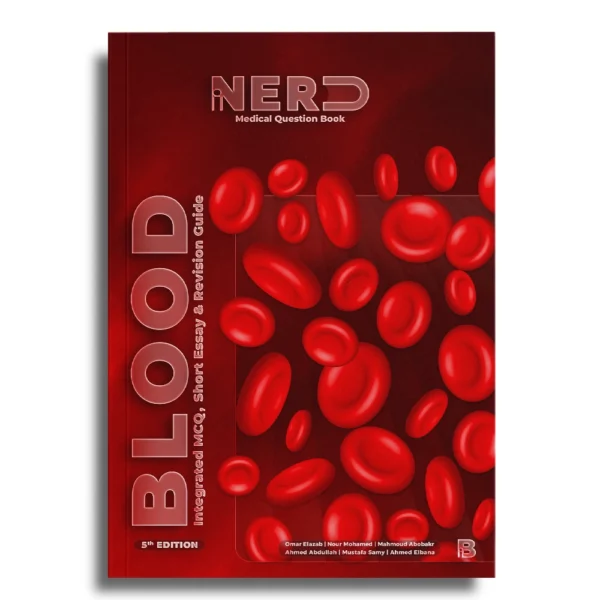
Blood Module iNerd Book 2027 – 5th Edition
The Blood Module iNerd Book 2027 is an integrated hematology question bank designed for undergraduate medical students studying the Blood Module. Built around MCQs, Short Essay questions, explained answers, and focused revision, the book helps students test their knowledge, recognize weak areas, and prepare effectively for module assessments and final examinations.
Instead of studying each discipline as an isolated subject, this fifth edition brings blood-related questions from anatomy, physiology, histology, biochemistry, pathology, pharmacology, microbiology, and parasitology into one organized resource. This integrated format reflects the way the Blood Module is taught and examined in modern medical curricula.
Why Choose Blood Module iNerd Book 2027?
- Integrated MCQs covering the complete Blood Module
- Short Essay questions for written exam preparation
- Explained answers that support understanding and self-assessment
- Questions organized across basic and clinical medical sciences
- High-yield coverage of important hematology concepts
- Updated questions for the 2027 academic year
- Additional updated questions and learning resources
- Periodic reviews and concise revision summaries
- Suitable for integrated and module-based medical curricula
- Useful for continuous study and final exam preparation
The Blood Module iNerd Book 2027 is question-based, so it works best after learning each topic from lectures or an explanation resource such as the Blood Module iMed Book. Students can then solve the related questions, analyze their errors, and return to difficult concepts for targeted review.
Integrated Hematology Question Bank
The Blood Module connects several medical disciplines. A strong question bank should test not only isolated facts but also the relationships between normal blood function, disease mechanisms, laboratory findings, clinical presentations, and treatment principles.
This book supports that goal through an integrated collection of exam-focused questions covering blood cells, plasma proteins, lymphatic tissues, hemoglobin, anemia, leukemia, hemostasis, bleeding disorders, infections, parasites, and relevant pharmacology.
The variety of questions helps students practise active recall while developing a more connected understanding of hematology.
Anatomy, Physiology and Histology Questions
The foundational sections assess the structures and normal processes students must understand before studying blood disorders.
Topics include:
- Properties and major functions of blood
- Plasma proteins
- Blood groups
- Erythropoiesis and blood cell production
- Red blood cell physiology
- White blood cell physiology
- Platelets and their functions
- Histology of blood and bone marrow
- Lymph nodes, spleen and thymus
- Hemostasis and normal coagulation mechanisms
These questions help students differentiate between closely related concepts and identify gaps in their understanding of normal hematological functions.
Hemoglobin and Biochemistry MCQs
The biochemistry questions connect molecular mechanisms with clinically important blood disorders.
Coverage includes:
- Hemoglobin structure and function
- Heme and globin synthesis
- Iron absorption, transport and storage
- Folic acid metabolism
- Vitamin B12 metabolism
- Glycolysis in red blood cells
- Important biochemical pathways related to hematology
Using the Blood Module iNerd Book 2027 for active recall can make complicated biochemical pathways easier to retain. Students can solve a group of questions after studying a pathway, check their answers, and repeat missed concepts until the underlying mechanism becomes clear.
Pathology and Clinical Hematology Revision
The pathology section focuses on high-yield blood and lymphatic disorders commonly encountered during undergraduate medical study.
Important areas include:
- Classification and mechanisms of anemia
- Megaloblastic anemia
- Red blood cell disorders
- White blood cell disorders
- Leukemia
- Lymphoma
- Platelet abnormalities
- Bleeding disorders
- Coagulation disorders
- Hypercoagulable states
- Thrombosis
Question-based revision helps students connect pathological changes with clinical presentations and laboratory findings. It also trains them to compare similar conditions, eliminate incorrect options, and select the most appropriate answer under exam conditions.
Blood Module Pharmacology Questions
The pharmacology content tests the important treatment principles related to hematology.
Topics include:
- Drug therapy used in different types of anemia
- Iron, folate and vitamin B12 therapy
- Anticoagulant drugs
- Drugs used in bleeding disorders
- Antimalarial drugs
- Drug-induced blood abnormalities
These questions reinforce the connection between mechanism of action, clinical indication, important adverse effects, and the underlying disease process.
Microbiology and Parasitology Questions
Blood-related infections form an important part of the integrated Blood Module.
Relevant questions cover:
- Viral infections affecting red and white blood cells
- Bacteremia and septicemia
- Systemic fungal infections
- Malaria
- Trypanosomiasis
- Leishmaniasis
- Toxoplasmosis
- Other clinically relevant blood infections
This coverage makes the Blood Module iNerd Book 2027 useful for revising how microorganisms and parasites interact with blood cells, immunity, and systemic disease.
MCQs and Short Essay Questions
MCQs develop rapid recall, careful reading, option elimination, and decision-making. Short Essay questions require students to organize their knowledge, explain mechanisms, create comparisons, and present complete written answers.
Combining both formats supports preparation for different styles of medical examinations.
For stronger results, students should answer each question before viewing the solution. Incorrect answers should be classified as a knowledge gap, misunderstanding, or reading error. This approach turns every mistake into a specific revision task.
Explained Answers and Additional Resources
The learning experience goes beyond the printed question bank. Students receive an answer booklet with explanations that clarify why each correct option is right and help correct common misunderstandings.
Additional updated questions, periodic reviews, and concise summaries support continuous learning throughout the academic year.
These resources create a complete study cycle: solve the question, check the answer, understand the explanation, review the related concept, and test yourself again. This makes the book useful for both daily practice and intensive revision before examinations.
Who Is This Book For?
The Blood Module iNerd Book 2027 is suitable for:
- Undergraduate medical students studying hematology
- Students following integrated medical curricula
- Students preparing for Blood Module assessments
- Learners searching for a Hematology Question Bank
- Students who need MCQs for active recall
- Students practising Short Essay questions
- Learners who want structured Blood Module revision
- Students using iMed for explanation and iNerd for practice
The book can be used throughout the academic term, during final revision, or as a companion to an explanation-focused hematology textbook.
How to Study with Blood Module iNerd
Start by studying one topic from your lectures or the iMed explanation book. Next, solve the matching questions in the Blood Module iNerd Book 2027 without looking at the answers.
Mark every uncertain response, not only the incorrect ones. Review the explanation behind each mistake and create a short list of weak concepts.
Repeat the missed questions after several days, then complete a mixed set under timed conditions. This cycle of learning, active recall, error analysis, and spaced repetition is more effective than repeatedly reading the same notes.
Before the examination, use the Short Essay questions to practise producing clear and structured answers from memory.







اشترى الكتاب سلمى أحمد (عميل موَثَّق) –
⭐⭐⭐⭐⭐
Alexis Marquardt –
this product is dominant.